
Most teams reach for A/B testing the moment they want to improve a page. It feels rigorous. It feels scientific. It produces a winner and a loser.
The problem: most teams don't have enough traffic to run A/B tests that actually mean anything. And even the teams that do have the traffic often skip the step that would tell them what to test.
Note
What is the difference between A/B testing and surveys? An A/B test shows two versions of a page to different visitors and measures which converts better — it tells you that one version works. A survey asks visitors a direct question — it tells you why something is or isn't working. Both are CRO tools. They answer different questions.
Note
TL;DR: A/B testing requires high traffic (1,000+ monthly visitors per variant for reliable results) and a specific hypothesis. Surveys require no minimum traffic, produce results in days not weeks, and are the only method that tells you why visitors behave the way they do. For most SaaS websites under 10,000 monthly visitors, a targeted survey is faster, cheaper, and more actionable than an A/B test. For teams with the traffic, surveys and A/B tests are most powerful when used together — survey first to understand the problem, then test the fix.
The traffic problem that makes A/B testing impractical for most teams
Here's what most articles about A/B testing don't tell you upfront: a properly powered A/B test requires hundreds — often thousands — of conversions per variant.
To detect a 10% relative lift in conversion rate (say, from 3% to 3.3%) with 95% confidence and 80% statistical power, you need roughly 10,000 visitors per variant. At 20,000 total visitors and a two-week test, that requires 5,000 visitors per day just for one test.
Most SaaS websites don't come close to that.
The A/B test significance calculator makes this concrete: enter your current conversion rate and monthly traffic, and it shows you the minimum detectable effect size. For pages with fewer than 5,000 monthly visitors, A/B tests can only reliably detect changes of 30-50% or larger. Everything smaller is noise.
This is not a theoretical problem. Teams run underpowered tests constantly. They end their test when one variant "looks better" at 80% confidence. They ship the "winner." They report a lift that never materializes — because the test was noise, not signal.
For those teams — which is most SaaS websites — surveys are not a consolation prize. They are a faster and more direct path to conversion improvement.
What surveys can find that A/B tests can't
A/B tests answer one question: which version converts better, in this specific population, at this specific moment in time?
They don't tell you:
- Why the losing version lost
- Whether the winning version would hold up with a different traffic mix
- What visitors wanted that neither version delivered
- What objection is blocking the 97% who didn't convert at all
Surveys answer all of these directly.
A pricing page visitor who leaves without signing up and is asked "What stopped you from signing up today?" will often tell you exactly what you need to know. You don't need 10,000 visitors. You need 50-100 honest answers. That data is available in 2-4 weeks on most SaaS pricing pages — and it arrives with context that no A/B test can provide.
The pattern repeats across almost every website we've seen: teams running test after test on headlines and button colors, collecting statistical significance on changes that move the needle by 1-2%, while the real conversion blocker — a pricing page that confuses visitors about what's included, a signup flow that asks for too much too early — goes unsurveyed and unchanged for months.
A single targeted survey on the pricing page typically surfaces that blocker in two weeks. Then you have something worth testing.
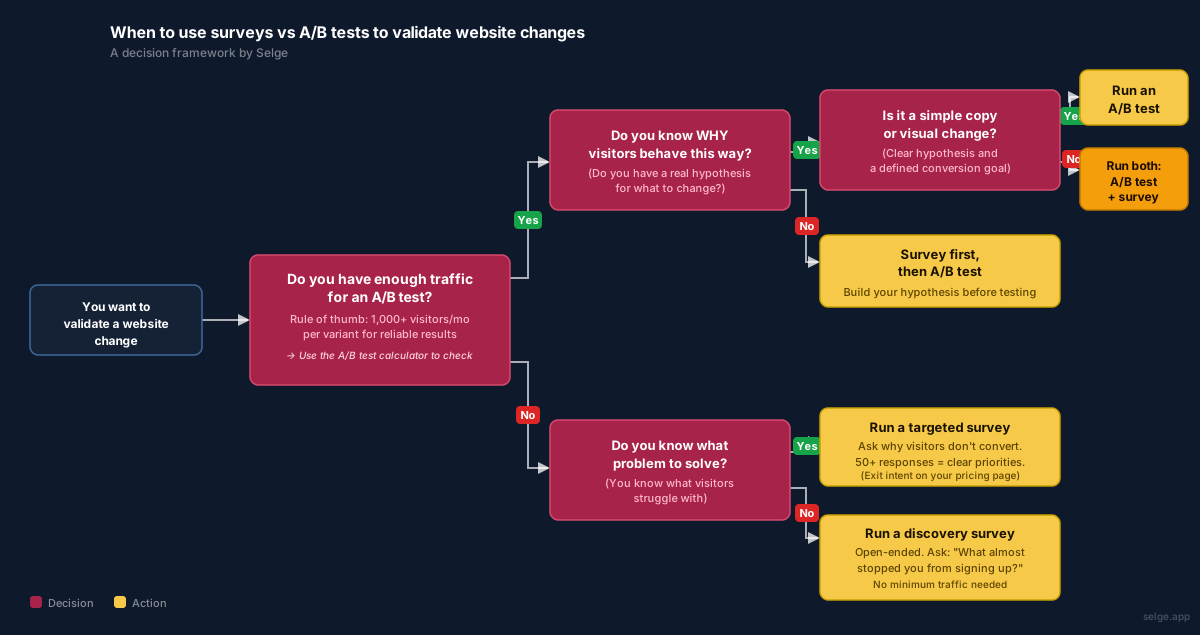
The decision framework: test or survey?
Before you decide how to validate a change, answer these questions in order:
1. Do you have enough traffic? Rough rule: 1,000+ monthly visitors per variant for a test with a realistic chance of reaching significance. If you're below that, a survey will produce actionable data faster.
2. Do you know what problem you're solving? If you're not sure why visitors aren't converting, you don't have a hypothesis to test. A discovery survey (open-ended, understand-first) comes before any test.
3. Do you know why visitors behave the way they do? If you know what is happening (high exit rate on pricing page) but not why, a targeted survey gives you the hypothesis. Then you test the fix.
4. Is it a simple copy or visual change? Simple changes with a clear hypothesis and sufficient traffic are ideal A/B test candidates. Complex changes — new page layouts, revised messaging, restructured feature descriptions — benefit from survey research before and after the test.
Here's that decision flow visualized:
When surveys beat A/B tests
1. You have fewer than 5,000 monthly page visitors
An A/B test on a page with 2,000 monthly visitors and a 3% conversion rate would need to run for months to detect a meaningful lift — and most teams don't have months. A targeted survey with Selge can collect 50-100 responses from the same page in 2-3 weeks, revealing the top 2-3 conversion objections without any statistical power concerns.
2. You need to know why before you know what to change
If you don't have a hypothesis, you can't run an A/B test worth running. Random testing — "let's try a different headline" — wastes time on low-probability changes. A single open-text exit survey question ("What would have made you sign up today?") generates a prioritized list of changes worth testing.
3. Your conversion rates are already very low
A/B testing with a 0.5% conversion rate requires enormous samples to detect any change. Surveys work regardless of conversion rate — you're asking every visitor who saw the page, not waiting for the 5 in 1,000 who converted.
4. The change affects copy or messaging
Copy improvements are hypothesis-driven by nature. You need to understand the visitor's language, objections, and mental model before you can write better copy. Surveys surface the exact words visitors use to describe their problem — the raw material for copy that converts. No amount of A/B testing substitute for that.
5. You need results in days, not weeks
A well-configured on-site survey with Selge can collect 50 meaningful responses in 3-5 days on a page with moderate traffic. That's faster than most A/B tests reach significance. If you're debugging a conversion drop that happened this week, surveys give you answers while the context is still fresh.
When A/B tests beat surveys
Surveys are not always the right tool. A/B tests are better when:
You have a specific, testable hypothesis and sufficient traffic. If your survey data already told you that "visitors don't understand the pricing structure," and you've rewritten the pricing table, a test is the right way to measure the impact.
You want to measure actual conversion behavior, not stated preference. What visitors say they prefer and what they actually convert on can differ. Once you've used surveys to understand the why, A/B tests confirm whether your solution actually changes behavior.
You're testing a change that affects user psychology in subtle ways. Some changes — button color, layout ordering, social proof placement — are hard to reason about from survey data. The effect is behavioral and implicit. A/B tests are designed for exactly this.
The stakes are high. For major redesigns or changes to core conversion flows, a properly powered A/B test is the only method that definitively proves causation. Surveys inform; A/B tests confirm.
How to use surveys and A/B tests together
The most effective CRO teams don't choose between surveys and A/B tests — they use them in sequence. Here's the loop:
Step 1: Survey to understand the problem
Deploy a targeted survey with Selge on the page you want to improve. Use exit intent to catch visitors who are leaving, or a timed trigger to capture mid-page opinions. Ask 1-2 focused questions: "What stopped you?" or "What's missing?"
Collect 50-100 responses. Read every open-text answer. Group them into 3-5 themes. Identify the top objection.
Step 2: Build a hypothesis from the survey data
Your survey data should produce a specific, testable hypothesis:
"60% of pricing page visitors said they couldn't understand the difference between our Starter and Pro plans. If we add a 'What's included' breakdown table, sign-up rate will increase."
This is a real hypothesis. You can test it.
Step 3: Build and test the fix
Implement the change in an A/B test. If you have the traffic, run it to statistical significance. If you don't, ship it and track conversion rate over 30-60 days.
Step 4: Survey again after the change
After you ship the fix, run a brief survey to confirm the objection is gone. Did the "I can't understand the plans" responses disappear from your exit survey? Did a new top objection surface? This closes the loop and surfaces the next priority.
This is the survey → hypothesis → test → re-survey loop. Each pass through the loop compounds. Teams that run this process consistently understand their visitors far better than teams that either survey without testing or test without surveying.
Comparison table: A/B tests vs surveys
| A/B Test | On-Site Survey | |
|---|---|---|
| What it answers | Which version converts better | Why visitors do or don't convert |
| Traffic required | 1,000+ per variant | Any (50+ responses meaningful) |
| Time to results | 2-8 weeks | 3-14 days |
| Cost | Developer time + tool | Low (Selge starts at $19/mo) |
| Best for | Confirming a hypothesis | Building a hypothesis |
| Reveals intent? | No | Yes |
| Reveals language/objections? | No | Yes (open text) |
| Requires a hypothesis? | Yes | No |
| Works on low-traffic pages? | No | Yes |
The simplest rule: survey first to understand, test to confirm. Most teams get this backwards — or skip the survey entirely and run underpowered tests on guesses.
How to set up a survey instead of an A/B test
If you're reading this because you wanted to run an A/B test but your traffic is too low, here's how to get equivalent insight with a survey in Selge:
1. Install the Selge script on your site — one snippet, no developer ongoing required.
2. Create a new survey — use the exit intent survey template for conversion pages, or a timed trigger if you want to capture mid-session opinions.
3. Ask 1-2 focused questions:
- "What stopped you from [taking action] today?" — multiple choice with an "Other" open text option
- "What would have made you [take action]?" — open text
4. Set exit intent as the trigger on your pricing or signup page. Set a 30-day dismiss cooldown. Publish.
5. Wait for 50 responses. Read every open-text answer. Find your top 2-3 objections. Make one change to address the top objection. Re-run the survey 4-6 weeks later.
This is one loop of the conversion research sprint — and it requires no traffic minimum, no statistical testing, and no developer involvement after initial setup.
Frequently asked questions
Should I A/B test or survey my visitors?
It depends on your traffic and what you know. If you have fewer than 1,000 monthly visitors per variant, survey first — A/B tests on low-traffic pages produce statistically unreliable results. If you have the traffic but don't know why visitors aren't converting, survey first to build a real hypothesis. If you have both the traffic and a clear hypothesis, run the A/B test. The short version: most teams should survey more and test less — not because testing is wrong, but because most tests are run without a strong enough hypothesis to justify them.
How do surveys complement A/B testing?
Surveys tell you the why behind visitor behavior; A/B tests confirm whether a specific fix changes that behavior. The most effective CRO process uses surveys to generate hypotheses and A/B tests to validate them. Without surveys, you're testing guesses. Without A/B tests, you're shipping changes without measuring impact. Together, each method makes the other more effective.
What is qualitative CRO research?
Qualitative conversion research is any method that collects open-ended, contextual feedback from visitors rather than measuring quantitative behavior. On-site surveys, customer interviews, and session replay analysis are all qualitative methods. Qualitative research tells you why visitors behave the way they do — the objections, confusions, and missing information that prevent conversion. It complements quantitative data (analytics, heatmaps, A/B test results) by explaining what the numbers show but can't explain.
What are the best alternatives to A/B testing for low-traffic websites?
For low-traffic websites (under 5,000 monthly visitors), the most useful conversion research methods are: (1) exit intent surveys — targeted questions to visitors leaving your conversion pages; (2) user testing — watching 5-10 people navigate your site and noting where they hesitate or get confused; (3) preference testing — showing two designs to visitors and asking which they prefer and why; (4) customer interviews — talking directly to recent signups about what almost stopped them. On-site surveys with Selge are the lowest-effort starting point: you get structured, quantifiable data at scale without scheduling calls.
How many responses do I need before acting on survey data?
For multiple-choice survey questions, 50 responses is typically enough to identify the top 2-3 objections — the distribution stabilizes quickly. For open-text responses, read every answer up to 100; after that, the themes repeat. Avoid drawing conclusions from fewer than 30 responses — early respondents skew toward the most vocal segment. For pages with fewer than 500 monthly visitors, plan for 2-4 weeks of data collection before reviewing results.
Can surveys replace A/B testing entirely?
No — and they shouldn't. Surveys tell you what visitors believe and feel. A/B tests tell you what actually changes behavior. These are different types of evidence. A visitor who says "the pricing is too expensive" in a survey might convert at a higher rate when you restructure the pricing table — even if you didn't change the price. The stated reason and the actual barrier can differ. Use surveys to understand the problem; use A/B tests to confirm the solution. For teams with too little traffic to run A/B tests, surveys are the best available alternative — but they're measuring intent and opinion, not behavior.
The bottom line
A/B testing is not the default tool for conversion improvement. It's one tool in a larger research process — and for most SaaS websites, it's a tool that requires more traffic than teams actually have.
Surveys are faster to set up, work at any traffic level, produce actionable data in days, and tell you something A/B tests fundamentally cannot: why visitors are not converting.
The best CRO teams use both. Survey to understand the problem. Test to confirm the fix. Survey again to find the next problem.
Start with a targeted survey on your pricing page. It takes 10 minutes to set up in Selge and will tell you more about your conversion problems than most teams learn in a year of analytics work.
Ready to find out why visitors aren't converting — without waiting months for A/B test results? Start free with Selge — one script tag, no credit card required. Or use the exit intent survey template to launch a survey on your pricing page in under 2 minutes.
Ready to hear what your visitors think?
Pick a template, paste one script tag, start getting real answers. No developer required.
Why didn't you sign up?
Conversion & CRO
Pricing page clarity check
Conversion & CRO
Homepage clarity check
Messaging & Positioning
Navigation check
Website & UX
What stopped you from signing up?
What stopped you from signing up today?
What stopped you from signing up today?
AI Insight
34% cite pricing. Consider adding a comparison table or rewriting plan descriptions using visitor language.